
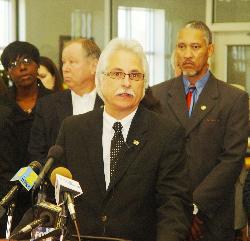
LFT President Steve Monaghan discusses the Federation’s support for Race to the Top at a December 21 press conference in Baton Rouge.
January, 2010
Dear Colleague,
Race to the Top (R2T) is essentially a contest in which states compete for federal dollars to improve public education. This “race” for a share of $4.3 billion in federal funds comes at a time when most states and many local school districts face difficult fiscal challenges.
The Louisiana Federation of Teachers has spent many hours in very frank and sometimes spirited discussions over these details with Superintendent Paul Pastorek and his R2T team. We have read and reacted to numerous draft proposals.
We made serious recommendations, many of which were accepted and written into the state’s Race to the Top program.
LFT came to the table determined to:
- Do all that we could to ensure that teachers have a voice in discussions about reforms that would continue to occur with or without R2T.
- Shape the debate in regard to critical issues like tenure, compensation, and evaluation.
- Make the Louisiana proposal as fair and as accountable as possible for teachers and students.
We knew that a number of school districts stand to lose more schools to state-takeovers, with dire consequences for teachers and other school employees.
We understood that there are school districts desperately in need of money now, and that thousands of children could benefit from this money. In those districts, R2T can bring more resources and eliminate or forestall school takeovers.
We know that R2T is very likely the model for future versions of the federal Elementary and Secondary Education Act, which most of us know as No Child Left Behind. But unlike No Child Left Behind, R2T is well funded. In fact, R2T includes an additional $350 million to move past the over-reliance on bubble-tests in favor of to richer assessments of student achievement – that is in addition to its initial $4.3 billion investment.
So, it is important for LFT to be at the table. By being there, we are able to influence the process and the product.
We still have serious concerns. We’ve seen noble efforts end badly before. In fact, our letter to the U.S Department of Education concerning R2T centered almost solely on the “unintended consequences” of post-Katrina reforms in New Orleans – thousands of fired educators, doubled health insurance premiums, and the silent bitterness that haunts those educators.
Educators deserve better, and must be treated with respect and as partners. Superintendent Pastorek involved the LFT in the development of the proposal, and he has agreed that teachers and their unions should be involved when districts write the local Race to the Top plans. In our non-collective bargaining state, this is one of the few times that the state has offered us a place at the table.
The Superintendent also agreed that that the plan must be flexible (in his word, “organic”). If changes really improve our schools, they should stay. But if it becomes more difficult for teachers to do their jobs, then programs should be modified and change direction. That’s why teacher involvement at the local level is critical. We’re best situated to know very quickly what is and what isn’t working.
Superintendent Pastorek has agreed with us that tenure should be celebrated, valued and respected. If bills are filed this legislative session to eliminate or diminish tenure, we’re hoping that we can count on him to stand with us against them.
There will be changes in the way teachers are evaluated. The federal government is pushing states to tie evaluations to student achievement, whether or not we take part in R2T.
Currently, evaluations can be unfair, overly subjective and very difficult to contest. We have always argued that tying student achievement to teacher evaluation will not produce student improvements. Student success is a much more complex issue.
Initially, the State Department wanted to base 75% of the evaluation on test scores, but LFT persuaded the Department to agree to two key changes.
The department agreed to reduce “student achievement” to 50% of the evaluation.
Then the department agreed to include a “Learning Environment Index” in the evaluation process. That means things that are beyond a teacher’s control must be considered. Those can include student mobility, the school’s safety and orderliness, the availability of resources, and parental involvement, among other things. Teachers’ evaluations of the school would trigger action to remedy the problems. Implemented properly, this would give teachers true voice.
Race to the Top will be implemented by local school systems. LFT made sure that teachers can be involved locally.
Our chapters will form teacher teams to work with school boards as Race to the Top plans are made, and to monitor programs that are implemented. We will demand accountability and inclusion in the plan. Once the grants are awarded to states in April, there will be 90 days for participating districts to develop a Scope of Action Plan and submit it to the State Department for approval. We want teachers to be involved in the development of the Scope of Action Plan.
We worked with the State to make the proposal as good as possible. We do not necessarily agree with all its ideas and policies. We are very troubled by some.
But we still believe that engagement is far better than disengagement, and dialog is better than silence. We came to the table in good faith and we participated in good faith.
The success of Race to the Top depends on the openness and honesty of all parties. We agree to behave as partners in this process as long as state and local education officials treat us as such, and honor the agreements we have made.
Sincerely yours,
Steve Monaghan